True Employee Cost Calculator: How to Calculate the Real Cost of Hiring an Employee with Essentia Business
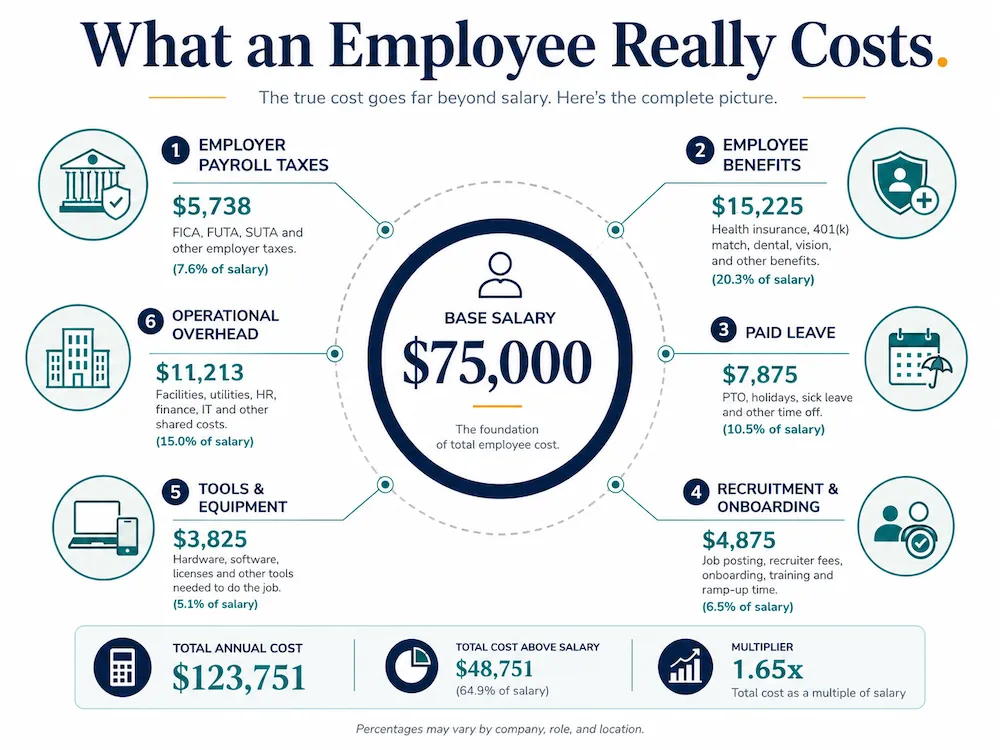
True Employee Cost Calculator: How to Calculate the Real Cost of Hiring an Employee with Essentia Business
Beyond Base Salary: Why the Real Cost of Hiring Is Always Higher Than You Think
Employee Cost: When expanding a team, founders, HR leaders, and financial managers often default to evaluating candidates based solely on their agreed-upon annual base salary. However, offering a candidate a $70,000 or $100,000 annual salary does not mean your company's bank account will only spend $70,000 or $100,000.
In reality, an employee's total financial impact—known in corporate finance as the fully burdened employee cost—is significantly higher. Mandatory payroll taxes, health and life insurance premiums, 401(k) or pension matching, paid time off (PTO), workspace equipment, software licenses, and administrative overhead routinely add 20% to 40% (or more) on top of the base salary.
Failing to calculate these hidden labor burden costs leads to inaccurate financial forecasting, eroded profit margins, and cash flow strain. To help growing businesses and HR leaders navigate workforce planning with total financial precision, the
Breaking Down the Hidden Costs: Payroll Taxes, Benefits, and Overhead
Calculating the true cost of an employee requires looking at four major categories that extend beyond gross wages:
1. Gross Base Salary
The foundational compensation agreed upon in the employment contract. While this is the most visible number, it represents only the starting point of your total expenditure.
2. Mandatory Payroll Taxes and Employer Contributions
Depending on your jurisdiction, employers are legally required to pay employer-side payroll taxes and statutory contributions. In the United States, for example, this includes employer FICA taxes (6.2% for Social Security and 1.45% for Medicare), Federal Unemployment Tax (FUTA), and State Unemployment Tax (SUTA). Internationally, similar social security and national insurance contributions apply.
3. Employee Benefits and Insurance
To attract top talent, companies offer competitive benefits packages. Common expenses include health, dental, and vision insurance premiums, employer 401(k) or retirement matching, life and disability insurance, and wellness stipends.
4. Operational Overhead, Equipment, and Onboarding
Every employee requires physical or digital infrastructure to perform their job effectively. This category covers laptop hardware, software seats (SaaS tools), office space allocation, training programs, recruiter fees, and administrative accounting costs.
To evaluate how these hiring costs impact your overall operational break-even threshold, you can integrate your employee cost calculations into the
The Financial Formulas Behind Fully Burdened Employee Cost
The
1. Total Annual Fully Burdened Cost
2. Labor Burden Multiplier (Labor Burden Rate)
Example: If an employee with an $80,000 base salary costs a total of $108,000 annually, the labor burden multiplier is:
3. Effective Hourly Cost per Worked Hour
Because employees receive paid vacation, sick leave, and public holidays, the hours an employee actually works are fewer than the standard 2,080 gross working hours in a year.
Understanding effective hourly costs is critical when setting billable rates for client-facing team members. You can align your employee's effective hourly cost directly with your agency's pricing targets using the
Strategic Benefits of Calculating True Employee Costs
Conducting a rigorous labor burden calculation prior to extending job offers offers critical advantages for executive leadership and finance departments:
Accurate Financial Forecasting: Prevents budget overruns by ensuring your annual operating expense (OpEx) budgets account for taxes, benefits, and equipment from day one.
Optimized Pricing and Profit Margins: Knowing the exact cost per hour for delivery personnel ensures that project pricing guarantees healthy gross margins. You can test your gross and net margins using the
Essentia Business Profit Calculator Contractor vs. Full-Time Employee (FTE) Comparison: Helps decision-makers objectively evaluate whether to hire a full-time employee or engage an independent contractor, weighing tax and benefit tradeoffs.
Compliance and Entity Structuring: For new businesses or local entities, understanding state/local tax impacts helps optimize payroll structure. Check state and filing requirements with the
Essentia Business LLC Fees & Taxes Guide
Step-by-Step: How to Calculate Your Employee Cost in Minutes
Using the
Enter Annual Base Salary: Input the gross annual salary offered to the candidate.
Input Estimated Employer Taxes (%): Add your total employer-side payroll tax rate (typically 8% to 12% in the US).
Add Annual Benefits Costs: Sum up annual health insurance premiums, retirement matching, and perks.
Include Annual Overhead & Equipment: Enter laptop hardware, software licenses, and onboarding expenses.
Set Paid Time Off (PTO) Days: Enter the number of vacation days, sick leave, and holidays provided.
The calculator instantly outputs your Total Annual Cost, Labor Burden Multiplier, Effective Hourly Cost, and Monthly Financial Burden.
Frequently Asked Questions About Employee Cost (FAQ)
What is a typical labor burden multiplier for full-time employees?
For most small-to-medium B2B companies and tech startups, the average labor burden multiplier ranges between 1.25 and 1.40 (25% to 40% above base salary). High-benefit industries or executive positions with large bonuses can see burden rates exceeding 1.50 (50% above base salary).
What is the difference between gross pay and fully burdened cost?
Gross pay is the total wage paid directly to the employee before employee-side tax deductions. Fully burdened cost includes gross pay PLUS all additional costs paid directly by the employer (employer taxes, insurance, perks, equipment, and administrative costs).
How does paid time off (PTO) affect an employee's effective hourly cost?
While PTO does not increase the total dollar amount spent annually, it reduces the total number of productive hours worked. As a result, the cost per actual worked hour increases, which must be factored into client billing rates and capacity planning.
Conclusion: Make Data-Driven Hiring Decisions
Expanding your team is one of the most effective ways to scale a business, but sustainable growth requires complete visibility into workforce expenditures. By calculating the fully burdened cost of every new hire, you protect your bottom line and build a resilient organization.
Calculate your workforce expenses today with the
Sponsored — Affiliate
Amazon Business & Tech Offers

Starface Hydro-Star® Recovery Hydrocolloid Star-Shaped
$25.99

Estée Lauder Little Black Primer™ Tint. Amplify. Set.
$30.00

Amazon Fire TV Stick 4K Max with Alexa Voice Remote Pro
$84.98

Dell XPS 13 OLED Review (2026): Is It the Ultimate Business Laptop for Executives?
$0.00

Blink Video Doorbell + Outdoor 4 – Wireless Doorbell
$103.99

Apple AirTag (2nd Generation) - 4 Pack: Tracker for
$89.99
Prices and availability are accurate as of publication. We may earn a commission at no extra cost to you.
Share this article
Help others find it — share on your favorite network.
Comments & Reader Rating